What are you worth?
A Bach Vespers Reflection
The following was a reflection from the Bach Vespers service at St. Thomas Episcopal Church, Terrace Park, Ohio, on November 20, 2022.
As the daylight grows shorter at this time of year, the leaves are fallen, and a bitter cold slaps at our skin. There is something in the air. You hear about it in churches. You are aware of it in stores. Organizations all around us are bubbling with its spirit. You know what I am talking about, don’t you?
I am talking about money.
With the end of the year comes an avalanche of donation opportunities. Churches are discussing their budgets; non-profits are asking you to consider one more gift before the calendar turns to 2023. Giving Tuesday is a thing, right?
The Bach Ensemble and St. Thomas are not exempt from this year-end discussion of giving, of course, and I do hope that you will continue supporting our endeavor. You may even hear from me in the coming weeks. I am also happy to have a very real example of what generosity can provide as we enjoy the first performance with our new Dowd harpsichord, made possible thanks to the gifts of four couples. I hope that you all will attend the dedicatory recital of the instrument in March and invite you to come to the chancel after the service to get a closer look.
But, tonight, I don’t want to talk about your money. I do want to talk about your worth. What are you worth? What is your value to this world, to your friends, your family, your colleagues, and your neighbors?
If you are worth something, and I suggest that each of you is worth a great deal, that leads to a second question: to whom do you owe for your worth? Is it the result of your talents and hard work? If so, you owe no one. Is it your parents? Your community? The Christian answer is that your worth was established the moment you became you. The ultimate value of a person is not rooted in their abilities or achievements or their circumstances, but in the basic dignity of being human.
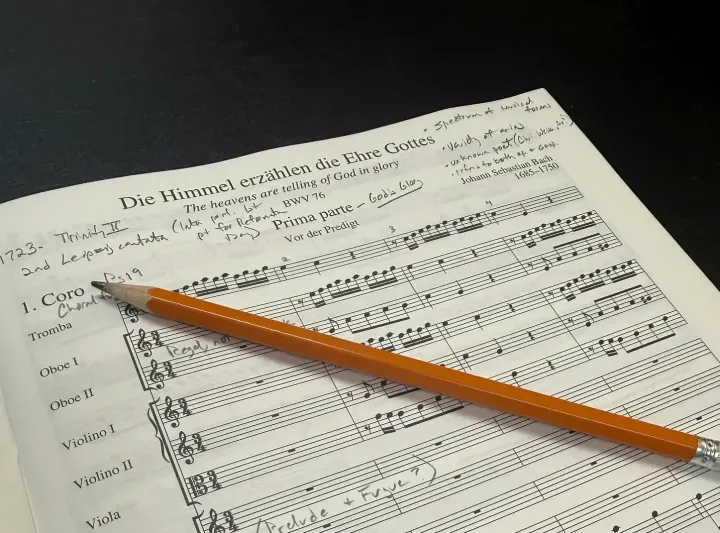
This language of economics–worth, value, and debt–is precisely the language that Bach’s librettist, Salomo Franck, used for tonight’s cantata. Franck was arguably the best librettist Bach ever had a chance to work with. He was not only a poet but also a lawyer and scientist. He held an important position in the court of the Duke of Saxe Weimar, where one of his duties was to manage the numismatic collection. (You may know what this means, but I had to look it up. He was charged with caring for the Duke’s remarkable collection of coins and currency.)
The value of coins depended in part on their condition. If they were stamped improperly, they were considered counterfeit. They could become dingy and degraded, necessitating their removal from circulation. They could also be cleaned and restored, returning their value. All these concepts, which Franck would have encountered on a regular basis, are important symbols in the libretto.
In tonight’s reading, Jesus uses the stamped image of Caesar to indicate to whom the coins ultimately belong. What belongs to God is not the coins stamped with Caesar’s image; it is, instead, the human heart, figuratively stamped with the Creator’s image, that belongs to God. In the language of the cantata, this is the debt we owe back to God: our hearts.
Our hearts can become marred, dingy, and perhaps counterfeit. It depends in part on what we have stamped them with. The late author David Foster Wallace wrote the following:
“in the day-to-day trenches of adult life, there is actually no such thing as atheism. There is no such thing as not worshipping. Everybody worships. The only choice we get is what to worship. And the compelling reason for maybe choosing some sort of god or spiritual-type thing to worship—be it JC or Allah, be it YHWH or the Wiccan Mother Goddess, or the Four Noble Truths, or some inviolable set of ethical principles—is that pretty much anything else you worship will eat you alive. If you worship money and things, if they are where you tap real meaning in life, then you will never have enough, never feel you have enough. It's the truth. Worship your body and beauty and sexual allure and you will always feel ugly. And when time and age start showing, you will die a million deaths before they finally grieve you.”
Wallace is asking the same question that Franck and Bach ask in this cantata: What do you worship? What image is stamped upon your heart? The entire piece may be the best sermon on money you will ever hear. And at the core is this truth: the heart should be the currency of love, stamped with the image of the divine, and loaned to us for good use.