The Opposite of Sorrow
On seeing patterns and finding meaning
The following reflection was shared at Bach Vespers, April 26, 2026, at St. Thomas Episcopal Church.
Human beings, from our beginnings, have been pattern-seeking creatures. We look at the stars and find constellations. We organize pitch and rhythm and discover music. We are drawn to symmetry and balance, whether in faces, architecture, poetry, or the stories we tell.
Patterns are not merely pleasing, though. They help us remember. Plainchant in the Christian Church developed, in part, to aid in the memorization of biblical texts, psalms, and prayers. Culture is largely preserved through patterns: the stories, the rituals, and the songs we pass down. These things can hold a community together across centuries. At the most fundamental level, our instinct for pattern helps us answer the question: What comes next?
Patterns also help us make meaning. We need to know whether grief has a shape, whether suffering can become wisdom, and whether death is the end. Patterns do not necessarily answer those questions, but they give us a way to ask them.
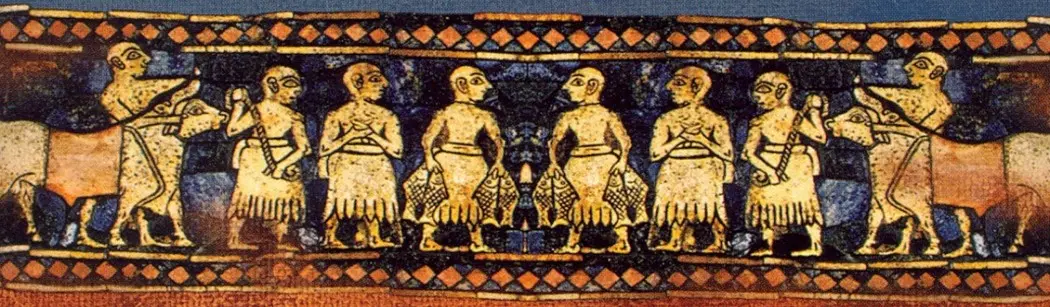
Chiasm is one of the oldest patterns we find in human art and literature. The word comes from the Greek letter chi, shaped like an X. A chiastic structure is one in which ideas move toward a central point, or axis, and then reflect back in reverse order. We cannot point with certainty to the earliest example of chiastic art, but we find structures deep in the ancient world — in Mesopotamian, Semitic, Greek, and biblical texts. By the time we encounter chiasm in Scripture, it is already an established way of shaping meaning.
Bach seems to have been especially drawn to this kind of structural and symbolic thinking, from his earliest works to his latest. Next year, the Bach Ensemble’s performance of his Mass in B Minor will illustrate chiastic structure in one of his final works. But tonight we can find the same kind of structure in what is perhaps the very first cantata he composed: Christ lag in Todesbanden, BWV 4.
Although its exact origin is uncertain, the cantata is generally thought to have been written for Easter Day in or before 1707. To modern ears, it may not seem particularly “Easter-like.” It is austere, severe, and ancient-sounding. But this is not a piece about Easter morning. It begins in the tomb.
The cantata is based on a chorale by Martin Luther, whose text draws on the ancient Easter sequence Victimae paschali laudes — “Praise to the Paschal Victim” — and its image of a battle between Life and Death. Luther also chose a familiar and beloved medieval tune associated with the older Easter hymn Christ ist erstanden, or Christ is risen. Luther’s aim was to expand that Easter acclamation and open it to the deeper metaphysical drama hidden inside it.
The older hymn says: Christ is risen; therefore rejoice.
Luther’s hymn says: Christ was captive to death. He entered death. Death and Life waged war. And in taking Christ, Death itself was undone.
If you listen carefully, the structure of this drama is chiastic in nature. Bach intensifies this by arranging the vocal movements of the cantata in a similar form:
Chorus — Duet — Solo — Chorus — Solo — Duet — Chorus
It all turns on the fourth movement, which presents the heart of the Easter mystery:
Es war ein wunderlicher Krieg —
“It was a wondrous war.”
This is the center of the chi, the crossing point of the X. Death binds Christ, but Christ breaks Death. The grave swallows Life, but Life swallows the grave. Easter joy is not the opposite of sorrow. Easter joy is sorrow turned inside out.
The deepest transformations we know do not happen by escape, but by passage. Sometimes the way forward is not around the obstacle, but through it.
When my church choir complains about a piece they do not particularly enjoy, I sometimes tell them, “You can do almost anything for three minutes.” Here, Christ does not conquer death by avoiding it, but by entering it. This is a severe message, reflected in the severity of the music.
That severity is part of the cantata’s gift. We live in a world marked by grief, anxiety, loss, and the recurring fear that darkness may have the final word. In every age, people are tempted to believe that their own moment is uniquely troubled. But history suggests otherwise. We are alive in a flawed and fearful world, as all who came before us were, and we are challenged to make meaning, courage, and faith within it.
Bach does not answer our fear with denial or easy consolation. He answers it with passage. This may be why the chiastic structure feels so fitting: chiasm is the shape of reversal, the shape of transformation, the shape of a story turning at its deepest point. For Christians, that great crossing point is the cross itself — the great chi, the first letter of Christos. But even for those who may not share the Christian faith, there is something worth considering. Great art does not merely entertain; it proposes a way of seeing, a way of making meaning, and a way through. Tonight’s music suggests that darkness need not have the final word, and that the place of greatest suffering may also become the place of deepest revelation.