Our Little Project
A Bach Vespers Reflection
The following was a reflection from the Bach Vespers service at St. Thomas Episcopal Church, Terrace Park, Ohio, on September 4, 2022.
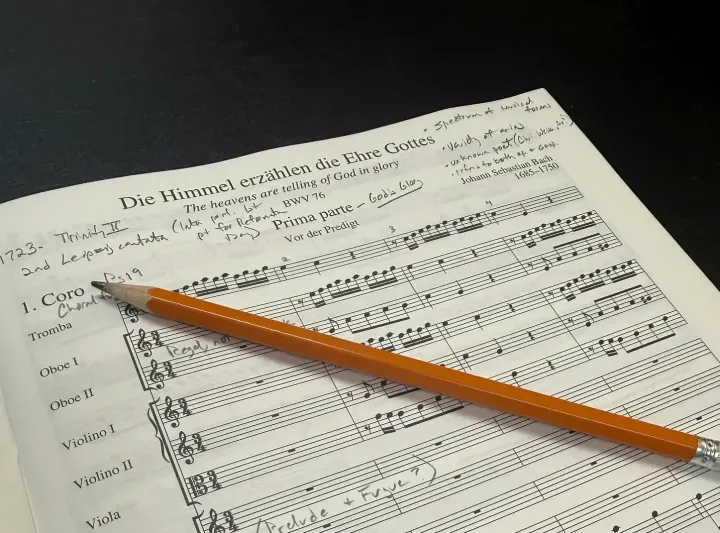
Welcome to Bach Vespers. Tonight marks the beginning of our 12th full season of evening services featuring the sacred cantatas of Johann Sebastian Bach. Typically, I use the cantata of the evening as the starting point for this reflection, but I thought I would instead offer a few thoughts and some background as to the nature of this service, something violinist Gerry Itzkoff and I have referred to over the years as “our little project.”
“Little”, of course, is an understatement. Bach composed hundreds of cantatas, about 200 of which have survived. We have managed to perform more than seventy of them in this little church. We would like to perform them all. It will take an enormous amount of time, talent, and treasure to do it. There is nothing little about that.
Take a minute to consider the collection of skill you see before you. The cantatas are difficult works of art to mount. There are years of practice sitting in the chancel, each minute of which was a necessary part of what you hear this evening. These deft fingers, these attuned ears, and minds, the spirits. Some of the artists here are at the peak of their professional careers. Some may be at their twilight. Others are just embarking on a future of music-making. I stand before them, as you do now, and am humbled. Nothing little about that either.
And what about the ingredients of our feast? The Vespers service is the oldest office in Christianity, dating back to Hippolytus in the 2nd century. It likely was based on a Judaic tradition of evening prayer going back much further than that. For thousands of years, human beings have sought reflection at the end of the day and the lighting of the evening lamps. The Phos Hilaron with which we begin each Vespers is the oldest Christian hymn we know, and whose title means “lamp-lighting hymn.” Interested in a perfect evening routine? Look to the Vespers: light a candle, read and listen to something profound and beautiful, reflect on your day, and show gratitude.
I mustn’t leave out the cantatas. I’ll save for another day why I think Bach’s music stands apart from other composers. Instead, I would like to consider the cantatas in the light of our ensemble’s motto: Timeless Music Today.
“Timeless Music.” Tonight’s cantata, as an example, was composed in 1724 and first performed on Sunday, September 3 of that year. That means that yesterday it turned 298 years old. For reference, the oldest surviving building in Cincinnati was built 218 years ago, so 80 years after Bach wrote this music. Somehow that makes it seem both very near and very far at the same time.
The cantata is based on a text published in 1540. That’s 482 years ago. 184 years later, Bach composed this cantata. That’s as far back in history to Bach as Tennyson is to us today. The chorale tune, the melody, is based on a secular tune from 1512. Now we are 510 years back from tonight.
Between a 510-year-old tune and a 2000-year-old service, it is clear where the “timeless” part of our motto comes from. But what about the second part: today?
If you read our promotional material, you will often hear about our goal to put Bach’s music in context. By this, we mean to suggest that a concert experience of Bach’s cantatas is incomplete, like an un-staged opera. The music was intended to be surrounded by a spirit of sacred reverence. It should be accompanied by the readings which it inspired it. It should be the focal point not just of our senses but of our souls.
And while these considerations are at the forefront of what we try to do, there is another context that we try to put this music into.
The context is you and me. It is this church. St. Thomas. Terrace Park. Sunday evening. September 4, and 5:?? p.m. Yes, we are trying to put the cantata into some sort of historical and religious context, but more importantly, we are trying to put this into the context of our presence tonight.
That is the context by which this music becomes transcendent.
The most important lesson I can pass on to your conductors is that you don’t conduct music, you conduct people. I don’t conduct Bach. I conduct Gerry, Kevin, Jim, Jackie, Jennifer, Maren, Ryan, and Rachael. You are not the congregation. You are Lance, Maggie, Buz, Brad, Beth, John, and Jane. We are the context into which we put Bach’s song. We put it into this space, our space, our minds, and our hearts. We hold it together, a shared treasure. And by its light, we illuminate ourselves to each other.
You see, the Vespers service and its ancient sacredness, Bach’s cantatas, and their artistic magnificence: they are merely tools in our endeavor to create a community. “Our little project” is not trying to perform 200 cantatas. “Our little project” is using this music, these prayers, as our journey towards the divine and towards one another.
It is the hand you hold, and not the hand you imagine that matters.
Tonight, we begin another season of music-making and community building. I hope that you will be a constant presence with us this year. That is a commitment I’m asking you to make. I hope that you will invite others to join you. I’ve been told by many that Bach Vespers is the best-kept secret in Cincinnati; it's time that it is not a secret anymore.
Thank you for being a part of “our little project.”